
How AI Agents Are Replacing Virtual Assistants: Automating Workflows, Cutting Costs, and Boosting...
Tendering is one of the most resource intensive processes in many organisations.
Teams spend countless hours searching documentation, responding to repetitive questions, tailoring language to evaluation criteria and coordinating inputs across multiple stakeholders. Deadlines are tight, compliance is critical, and the cost of a missed detail can be high.
This is where AI, and increasingly AI agents, are creating a step change in how tenders are prepared, reviewed and submitted.
When implemented correctly, AI does not replace human expertise. It removes friction, reduces risk and allows teams to focus on strategy, differentiation and value.
The Problem With Traditional Tender Processes
Most tender teams face the same challenges:
- Reusing outdated or inconsistent content
- Manual document searches across folders, drives and past submissions
- Time pressure leading to rushed reviews and errors
- Difficulty aligning responses to evaluation criteria
- Over reliance on a small number of subject matter experts
The result is often a process that is reactive, exhausting and difficult to scale.
AI changes this by turning tendering into a structured, supported and repeatable workflow.
Using AI to Support Tender Preparation
At the most practical level, AI can assist tender teams by:
- Analysing tender documents and extracting key requirements, deadlines and evaluation criteria
- Matching requirements to existing capability statements, policies and past responses
- Drafting first pass responses aligned to scoring frameworks
- Flagging compliance gaps or missing evidence
- Ensuring tone, terminology and structure remain consistent
This alone can reduce preparation time significantly while improving response quality.
However, the real shift happens when organisations move from using AI as a tool to deploying AI agents as part of the process.
What Are AI Agents in Tendering?
AI agents are task specific, semi autonomous systems designed to operate within defined boundaries.
In a tender context, different agents can be assigned roles that mirror a high performing bid team, such as:
- A compliance agent that checks every response against mandatory criteria
- A content agent that pulls approved language from internal knowledge bases
- A reviewer agent that assesses clarity, alignment and duplication
- A risk agent that flags ambiguous claims or unsupported statements
These agents work together under human oversight, accelerating the process while maintaining control and accountability.
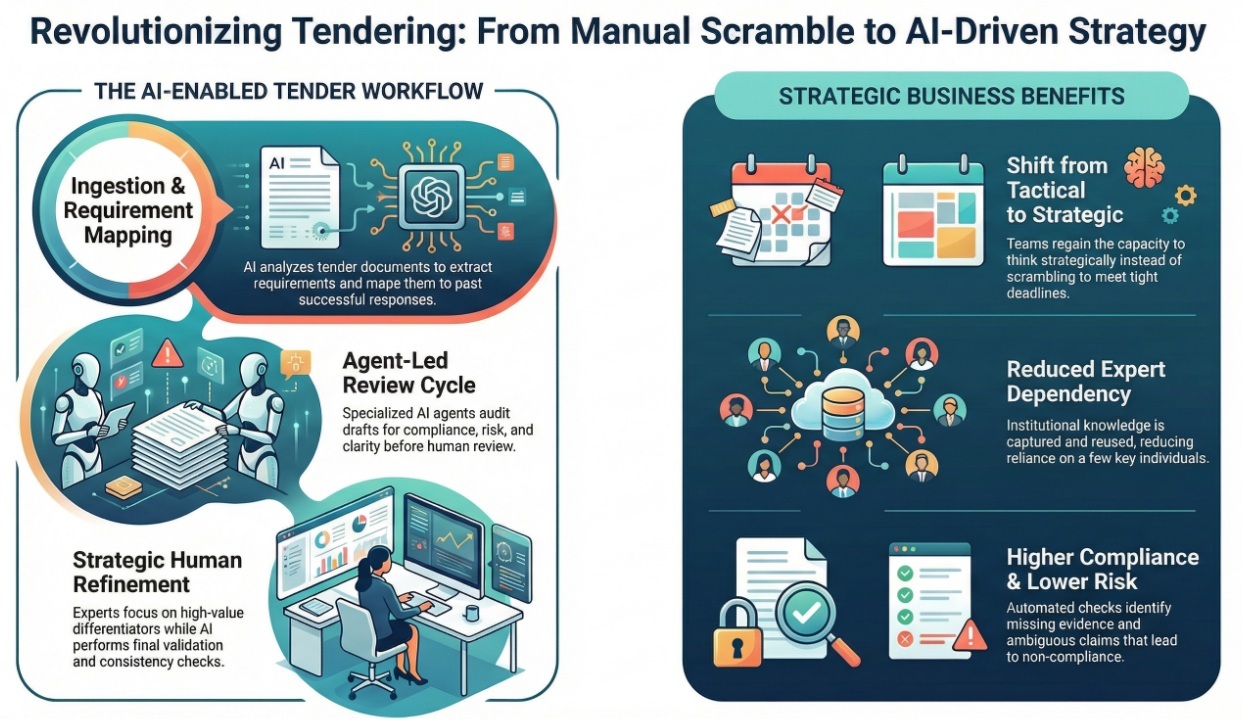
A Practical AI Enabled Tender Workflow
A mature AI supported tender workflow typically looks like this:
- Tender ingestion
The tender document is uploaded and analysed for structure, requirements and scoring priorities. - Requirement mapping
AI maps questions to internal knowledge, policies and previous submissions. - Draft generation
First draft responses are generated using approved language and contextual understanding of the organisation. - Agent review cycle
AI agents review for compliance, clarity, risk and alignment to evaluation criteria. - Human refinement
Subject matter experts refine strategic positioning, value propositions and differentiators. - Final validation
AI performs a final consistency and compliance check before submission.
The result is a faster, calmer and more controlled tender process.
The Benefits Go Beyond Speed
While time savings are significant, the real value of AI in tendering is consistency and confidence.
Organisations see:
- Reduced reliance on a small number of experts
- Improved quality across all submissions, not just flagship bids
- Stronger alignment to evaluation criteria
- Lower risk of non compliance
- Better reuse of organisational knowledge
Most importantly, teams regain the capacity to think strategically instead of scrambling tactically.
Governance and Trust Still Matter
Tendering is a high risk activity. This means AI must be deployed with clear governance, approved data sources and defined human oversight.
Strong AI governance ensures:
- Confidential information is protected
- Outputs are auditable and explainable
- Decisions remain human led
- Ethical and contractual obligations are met
AI should support judgement, not replace it.
Is Your Organisation Ready?
AI enabled tendering is not about adopting another tool. It is about redesigning a critical business process so it is sustainable, scalable and resilient.
Organisations that succeed start with clarity:
- What data can AI access?
- What decisions must remain human?
- Where does AI add the most value?
From there, AI and AI agents can be introduced in a way that builds trust and delivers measurable impact.
Moving Forward With Confidence
AI is rapidly becoming a competitive advantage in tendering. Not because it writes faster, but because it enables teams to work smarter, with greater consistency and less risk.
If you are exploring how AI or AI agents could support your tender process, a discovery call can help identify what is realistic, safe and valuable for your organisation.
The goal is not to automate judgement. It is to remove friction so your best thinking has room to shine.