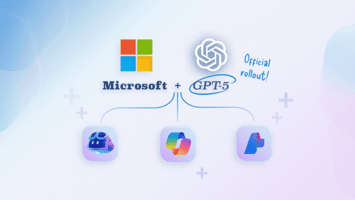
AI has just taken another major leap forward. Microsoft has officially integrated GPT-5 across its...
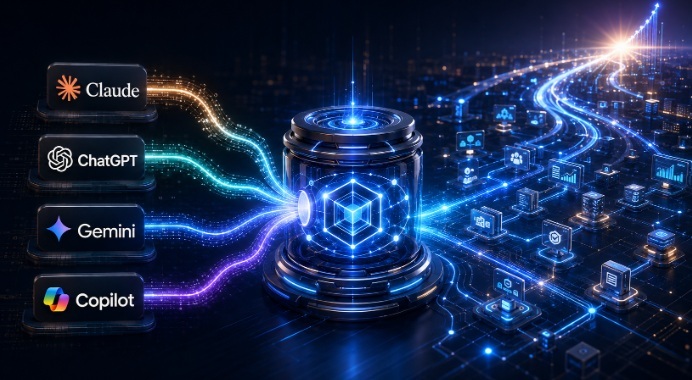
Most businesses have now assembled an AI tech stack.
They may use Microsoft Copilot for emails and documents, ChatGPT for research and content, Claude for complex analysis and projects, and Gemini across the Google ecosystem. Teams are building prompts, projects, scheduled tasks, custom GPTs and isolated automations.
This is valuable progress. But it is not yet AI transformation.
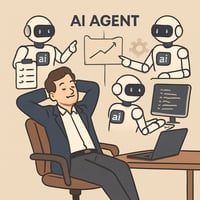
In most organisations, the person is still the integration layer. An employee copies information from one system, gives it to an AI tool, reviews the response, moves the output somewhere else and then completes the next step manually.
The tools are intelligent, but the workflow is still fragmented.
The next stage is to move from a collection of AI tools that people operate to bespoke AI agents that can operate complete, governed workflows across the business.
The AI tech stack was the starting point
Claude, ChatGPT, Gemini and Copilot have given businesses an accessible way to understand what generative AI can do. They have helped teams draft faster, analyse more information, automate repetitive tasks and explore entirely new ways of working.
However, many organisations are now encountering the limits of a tool-by-tool approach:
- Knowledge is spread across separate projects, chats and platforms.
- Employees repeatedly upload, copy and re-enter the same information.
- Automations depend on individual users and are difficult to govern at scale.
- AI outputs sit outside the systems where work is actually completed.
- Processes stop whenever human approval, system access or another application is required.
- Leaders have limited visibility over quality, security, cost and business impact.
A sophisticated AI stack can still leave the organisation with a collection of disconnected productivity gains rather than a transformed operating model.
What changes with a bespoke AI agent?
A bespoke AI agent is designed around a business outcome and the workflow required to achieve it.
Instead of waiting for a user to open an AI tool and write a prompt, the agent can be triggered by a business event, such as a new sales enquiry, a supplier invoice, an expiring contract, a service request or a change in operational data.
The agent can then:
- Gather relevant information from approved systems.
- Interpret that information using the most appropriate AI model.
- Apply the organisation's rules, policies and commercial logic.
- Take permitted actions across connected applications.
- Escalate exceptions or high-risk decisions to a person.
- Record what happened for monitoring, audit and improvement.
That is a very different proposition from asking an AI assistant to draft a response.
It is the difference between helping a person complete one task and orchestrating the workflow that produces the outcome.
Your infrastructure, your controls, your operating model
When we say an agent sits on your own infrastructure, this does not necessarily mean buying and maintaining physical servers.
For many businesses, the right architecture will be an agent deployed within their controlled cloud environment, private tenant or dedicated hosting arrangement. It can connect securely to approved business systems while using selected models from Anthropic, OpenAI, Google, Microsoft or other providers.
The model provides intelligence. The agent layer provides the business logic, permissions, integrations, memory, monitoring and control.
This architecture can give the organisation greater control over:
- Which systems and data the agent can access
- Where business data is stored and processed
- Which actions the agent is authorised to take
- When human approval is mandatory
- Which model is used for each type of task
- How outputs are tested, monitored and audited
- How usage, performance and cost are measured
- How the solution integrates with existing security and governance requirements
Importantly, owning the agent layer also reduces dependence on the interface or feature set of any one AI platform. Models will continue to change quickly. A well-designed agent architecture allows the business to select or switch models based on capability, risk, speed and cost without rebuilding the entire workflow.
From prompts to complete workflows
Consider a business that receives a new sales enquiry.
In a typical AI tech stack, an employee might copy the enquiry into Claude or ChatGPT, ask for research, draft a response, create a proposal, update the CRM and schedule a follow-up. AI assists at several points, but the employee still moves the process forward.
A bespoke sales agent could:
- Detect and classify the enquiry
- Enrich the company and contact information
- Review prior CRM activity and relevant account history
- Assess fit against the ideal customer profile
- Select the right industry case studies and service information
- Draft a personalised response and proposed next action
- Create or update the CRM record
- Prepare a proposal or meeting brief
- Route the material to a salesperson for approval
- Trigger the approved follow-up sequence
The person remains accountable, particularly at key decision points, but no longer has to coordinate every administrative step.
The same approach can be applied across finance, customer service, operations, procurement, compliance, HR and project delivery.
Agentic does not mean uncontrolled
The goal is not to give AI unrestricted access to the business.
The strongest agent implementations use bounded autonomy. The agent has enough access to create meaningful value, but operates within explicit rules, permissions and escalation thresholds.
Low-risk, reversible actions may run automatically. Higher-risk actions, such as approving expenditure, changing contractual terms, releasing sensitive information or making decisions about people, should require human review.
A robust implementation should include:
- Role-based access and least-privilege permissions
- Clear approval gates and escalation pathways
- Data classification and retention controls
- Logging and traceability of agent actions
- Testing against expected and unexpected scenarios
- Quality, risk and performance monitoring
- A reliable way to stop, override or roll back actions
- Named human ownership for every production agent
The ambition should be high, but the controls must be equally mature.
Where should a business begin?
Do not begin by asking, "Where can we build an agent?"
Begin by asking, "Which workflow is creating the greatest cost, delay, risk or missed opportunity?"
The best first candidates usually have four characteristics:
- They matter commercially. Improving the workflow can move revenue, margin, cost, risk or capacity.
- They happen frequently. The value compounds every time the agent runs.
- They follow identifiable rules. The process can be mapped, tested and governed.
- They span multiple steps or systems. There is meaningful value in orchestration, not just generating text.
Once the workflow is selected, map its triggers, data sources, decisions, actions, exceptions and approval points. Then define the target outcome and how it will be measured before choosing the technology.
The strategic shift
The first phase of enterprise AI was about access. Businesses bought licences and encouraged people to experiment.
The second phase was about adoption. Teams learned how to prompt, build projects and integrate AI into individual tasks.
The next phase is about execution. Businesses will deploy agents that combine intelligence, data, systems and governance to complete valuable work.
Claude, ChatGPT, Gemini and Copilot will remain important. But competitive advantage will not come from simply having access to the same AI tools as everyone else.
It will come from encoding your organisation's knowledge, processes and commercial logic into agents that are built for the way your business actually operates.
That is the move from an AI tech stack to an AI operating capability.
Ready to move beyond AI experimentation?
AI Surge helps organisations identify, design and deploy bespoke AI agents that connect with their existing systems, operate within clear governance controls and deliver measurable business outcomes.
If your teams are already using Claude, ChatGPT, Gemini or Copilot, the next question is not which licence to add.
It is which complete workflow you are ready to transform.
Start a conversation with AI Surge about building your first bespoke AI agent.